

In October 1990, sixteen young women made history when they marched up the gangway to join HMS Brilliant in Devonport.
These were the first female sailors to deploy at sea, and in three months they would be sailing towards the Gulf, and into a war. Among them was Jan Whittle, who since childhood had wanted to join the WRNS. “My father and grandfather were in the World Wars, and my brother was a policeman, so there was an appeal of service”.
Demand for places was high, and after 18 months on a waiting list she finally began her career in the WRNS. Jan undertook initial training at HMS Dauntless in Reading followed by specialist training as a Writer (Pay) at HMS Pembroke in Chatham, Kent. She then served in a number of shore establishments, including the Royal Marines Commando Training Centre at Lympstone in Devon. This was a period of change in the Royal Navy, including the ‘experiment’ to permit women to serve at sea. A call out for volunteers was made and Jan applied, and was successful.

Joining HMS Brilliant
“I’d never been on a (Royal Navy) ship before I walked up that gangway. I’d never been to sea: hadn’t a clue!” Jan was around ten years older than the other Wrens (who were in their late teens and early twenties). “We all joined the Brilliant on a Sunday afternoon, and I was made Killick of the Mess (the senior junior rate sailor in charge of the others).”
Jan’s role was working with the Marine and Weapons Engineers in the department’s Technical Office. The only female. “On my first day one of the men said ‘I don’t like the idea of girls at sea, and don’t think you’ll do a good job’. Two and a half years later he said to me ‘You did alright, lass.’”
No concessions were made for the Wrens on board a ship of 254 souls, apart from them having their own mess and sleeping quarters. “We had some angst from the younger lads; you always felt like you had to prove yourself.”
The others Wrens on Brilliant were Radar Plotters, Radio Operators, Writers, Stewards and Stores Accountants “The radar plotters also did seamanship duties on the upper deck, which included ships maintenance and assisting when the ship was docking or leaving harbour.”
Entering a War Zone
In late 1990 HMS Brilliant sailed to Portland for training in preparation for the Gulf. As international tensions increased a huge allied Coalition was forming in the region. Jan reflects: “You didn’t just have to adjust to a new routine; you had to prepare to enter a war zone.”
In January 1991, HMS Brilliant sailed to the Gulf. “Until you are in a war zone, you don’t know what it means.” The crew had to adapt to the new routine of defence watches – 8 hours on duty, then 8 hours off, then repeated.
HMS Brilliant was set to work as part of a fleet patrolling the Gulf and guarding the merchant vessels taking supplies to the ports for the front line of the Gulf War. All ships were potential targets by Iraqi forces.
“We had to go to Action Stations a few times – missiles would be shot at the fleet, usually flying over us. I was given the responsibility of being the Main Incident Board Operator in HQ1: to mark in the ship anything like fires or flooding in the event we were hit.”
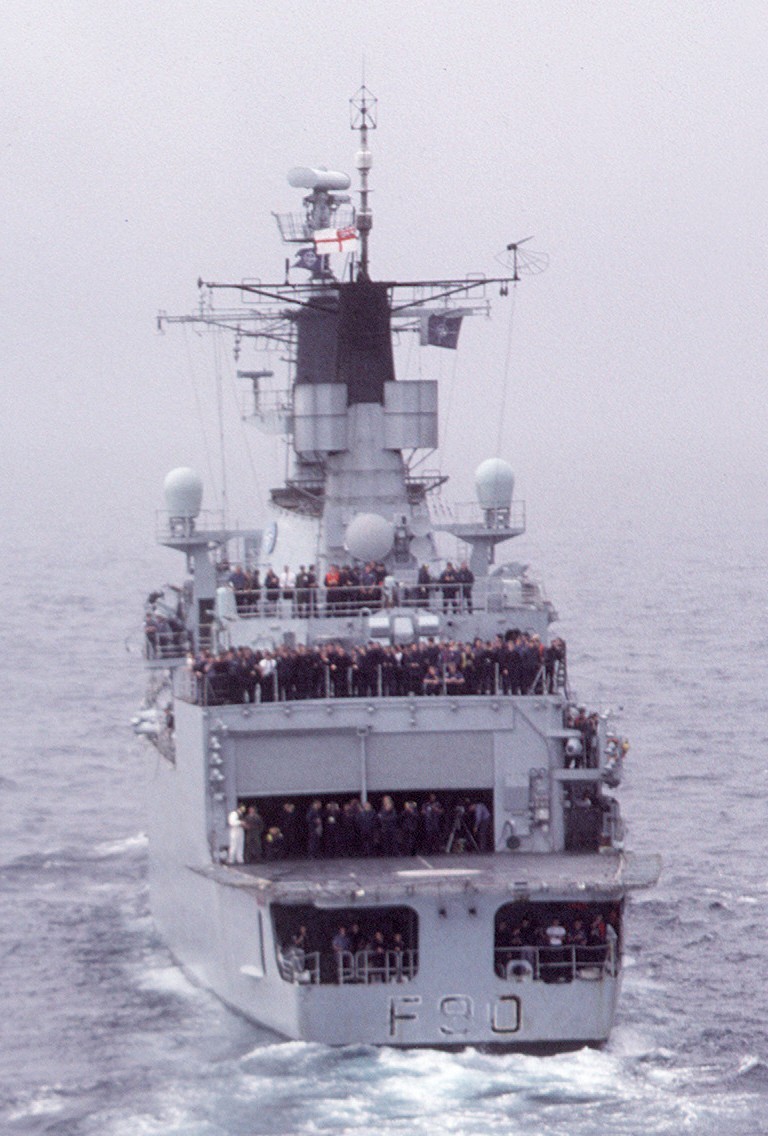
“You still had to do your day job in 8 hours on, then 8 hours off… I was living in a mess deck with the other Wrens – some asleep, some going on watch, some coming off. You form a great bond with everyone. In fact, we are still in touch 35 years later.”
“We escorted merchant ships into Kuwait and I could see all the fires from the burning oil wells, and we got covered in soot. We went ashore into Kuwait and the devastation was huge and shocking. Some things stick in your mind – like when a front-line unit came aboard the Brilliant for respite and to use the showers, before heading out there again.”
On another occasion the Brilliant was sailing with an American ship which hit a mine and “we shook like a tin can.”

“If we hadn’t proved we could do it, maybe there wouldn’t be so many women aboard ships now.”
Shortly after the conclusion of the war, the Brilliant went to the aid of a merchant ship on fire. “We fought the fire for 17 hours and towed it into Bahrain. Some of the men questioned where all the Wrens were. Then when the sailors took off their ‘anti-flash’ it was revealed that several of the Wrens had been firefighting with the hoses. That earned respect.”
Jan left HMS Brilliant at the start of 1993 and continued with a successful and fulfilling Navy career until 2006, including a deployment to the Falkland Islands and acting as PA to a Captain at RNAS Yeovilton.
Jan reflects on those young pioneering women on HMS Brilliant: “They are my proudest achievement. Trailblazers and very young, only just out of training and joining a ship that went to war. If we hadn’t proved we could do it, maybe there wouldn’t be so many women aboard ships now.”