
Matt Cook is an award-winning illustrator, well known in the art and publishing worlds. His perfect draughtsmanship captures people and places in detail, from crowds at Wimbledon to Tuscan landscapes.


Matt was one of the 10,000 Reservists who served in Op TELIC.
His famed illustrations of Iraq during the war were published in The Times and in a book. Less well-known is that Matt was one of the 10,000 Reservists who served in Op TELIC.
While studying for a graphic design/illustration degree he first heard about commercial drawing. On graduation, he landed the role as expedition artist for Operation Raleigh, in which young people volunteer for charitable work abroad. After four years, Matt explains: “I came back to the UK and I had this portfolio of drawings from Papua New Guinea, Brazil, Peru… and I started doing travel pieces for The Times.”
Parallel to his art was his passion for military service. “I was in Cubs and Scouts. We used to do Army Youth Team and survival weekends, so there was always a connection. To me it seemed fairly obvious when I found out about the Reserves.”
He ultimately joined the Parachute Regiment and trained for the rigorous P Company selection. “We trained two nights a week, and one was a ‘Phys’ night, and one was military training, (plus) it was every other weekend. So it was a hell of a commitment - I lost a girlfriend because of it…” He obtained his Paratroop Wings before joining the recce Platoon Patrols.
By 2003 Matt was an accomplished and in demand illustrator: “I did some stamps for Royal Mail, book covers and The Times just ticked along as a regular commission.”
As conflict in Iraq loomed, Matt received a call from The Times editor. “He said ‘What are you doing next week? Do you want to go to Iraq?’ and it was like - Oh my God, Yes!”
He was sent on five-day Hostile Environment Training. “That was when the reality of it was dawning. We’d do a bit of night navigation, setting up satellite phones, trauma management, counter-ambush, chemical attacks, a bit of driver training on muddy/sandy tracks. In hindsight, I used nearly all of that”.
He flew into Kuwait about two weeks before the war began, and gathered supplies before entering Iraq. “I ended up crossing the border alone in my Hertz hire car which wasn't how I saw myself going to war! I'd signed a letter in the rental place saying - no, I'm not going to drive into Iraq…”
“The Times provided me with a helmet, I had a kind of ‘grab bag’ which was my sketchbooks and water, compass - and some money… hidden in the bottom of my boots.” He’d bought the boots from an Army surplus store in England days before.


Navigating with an out-of-date map and scraps of information, he found his way to Basra
The Royal Horse Artillery had requested that Matt join them and he spent a couple of days with their forward team. “There was a bit of toing-and-froing and mortar fire, my first taste of war”.
He also drew the Irish Guards while on patrols with them.
Matt wanted to travel to Baghdad and found a local interpreter, Hamid, whom he grew fond of as they travelled together. They didn’t know the route they took into Baghdad had been re-named the ‘Thunder Run’. “(We) came across a squadron of tanks that had been hit by helicopter fire. Some were still smoking, but most of the fires were out. There were AKs and weapons lying around and there were a bits of body, and dogs chewing on bits of tattered uniform. It was like a Vietnam War film.”
All this time he was drawing and finding ways to file his images to The Times. “I kind of had to find a way of drawing fast. I started doing line drawings, which I don’t think I’d really done before - just pen and black lines.”
In Baghdad he also illustrated the daily lives of civilians after the initial invasion.


He left Iraq as a civilian (aboard HMS Ark Royal) but returned a soldier
There was no question in his mind. “They were kind of taking volunteers and we got mobilised as a platoon, so as all mates and friends, which was brilliant.”
After six months’ training he was deployed in January 2004. “We were Force Protection at Basra Air Station, so we ended up guarding the joint helicopter force and sentry duties”. They also went on convoy escort protecting weapons inspectors, engineers and politicians. “We’d be out and about. One of our vehicles got hit by an IED and we took some casualties, so that brought in home. That was when the insurgency started kicking in.”
“There was definitely a different feel. Some people were throwing stones by now; I got none of that the first time. The uniform made a big difference.”
“We had probably 90 of us deploy and maybe 10 got injured.”
One time Matt was tasked with escorting a Brigade Commander’s Close Protection team, “so I had to get the lads up early, sign out our vehicles, do our checks… Just as we were heading off, we heard (our) route had been closed as an RPG team had been spotted”.
They rendezvoused with the Close Protection team’s two armoured vehicles, and as their small convoy progressed: “suddenly the road was completely deserted, just a pile of rubbish on fire. It didn’t feel right. I remember saying to the lads “be really careful, this is where the RPG team were spotted’. We had stripped-down Land Rovers, really basic, just two guys in the back with weapons. So, we went through very slowly, checking the rooftops… We got through that, but I remember the hairs on the back of my neck standing up.”
"Then as we were driving out of Basra we came under automatic weapons fire.”
In downtime, Matt was still illustrating
“When someone was going back for R&R, I’d give them a package of drawings and ask if they could post them to The Times.”
After six months his tour was over. Matt the soldier would go on to a deployment in Afghanistan. Looking back on his photos and drawings of Iraq Matt reflects: “my biggest take from this is the friends I have made. My best mate two roads up, we deployed together and have been best mates ever since… I mustn’t take it for granted.”
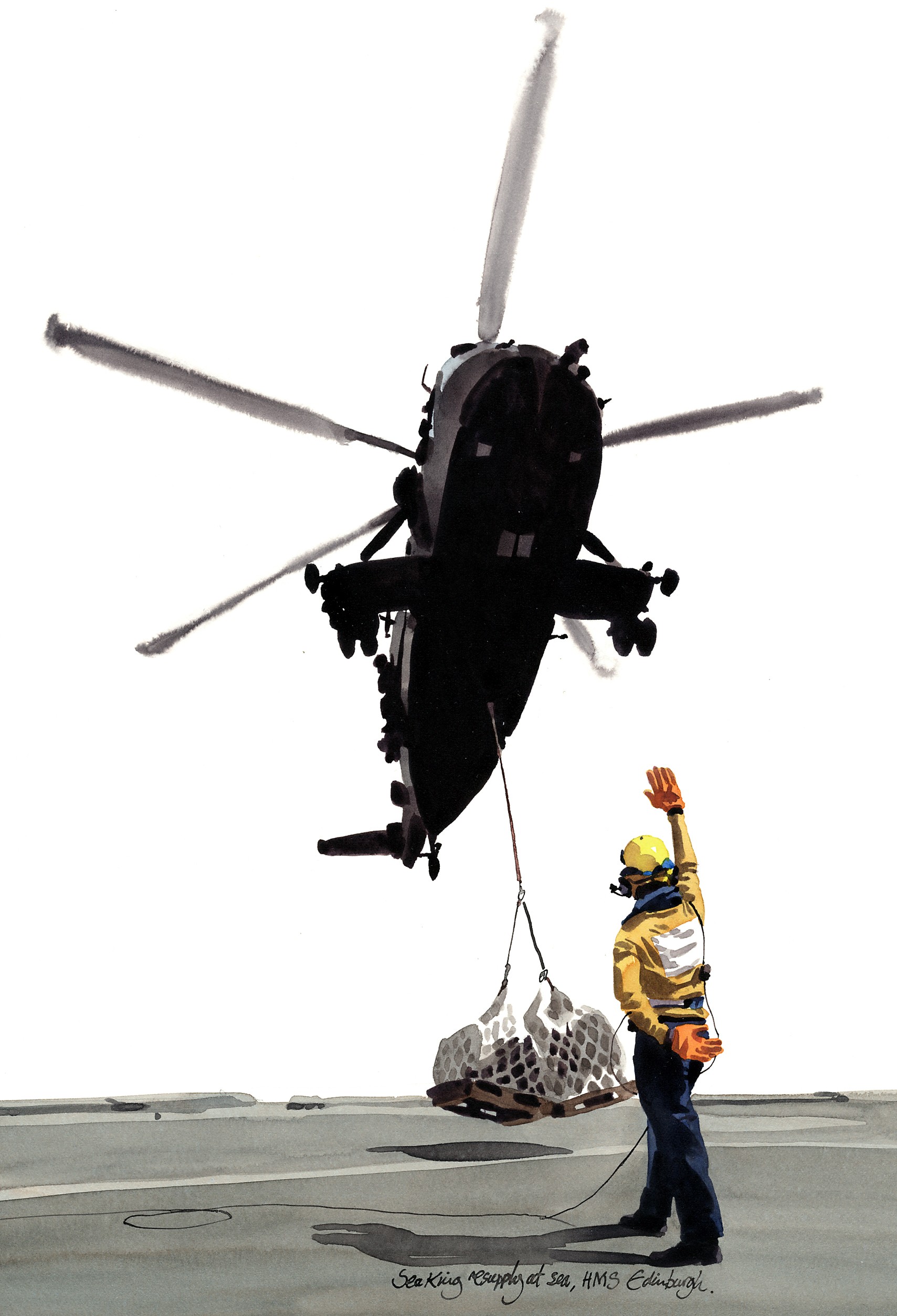 All illustrations © Matt Cook