
About this research
RBL’s Needs Analysis brought together robust insight to build a comprehensive picture of the UK Armed Forces community, while also revealing important gaps in our understanding of demographics and needs.
To address some of these gaps, in 2025 we commissioned the
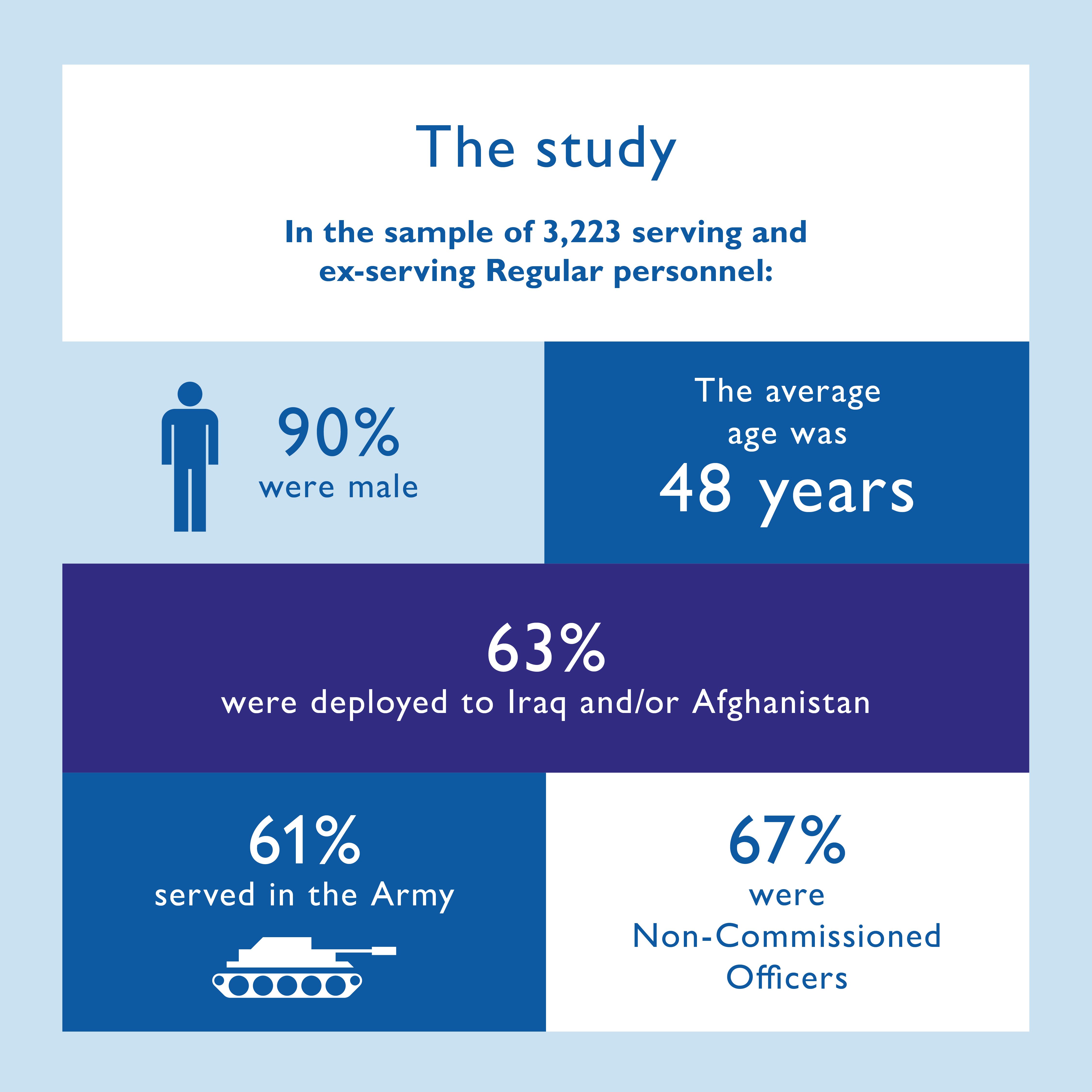
King’s Centre for Military Health Research (KCMHR) to analyse data from Phase 4 (2022-23) of their large-scale Health and Wellbeing cohort study.
KCMHR’s cohort study:
- Has been ongoing since 2004
- Tracks those who served in the UK Armed Forces during the Iraq and Afghanistan-eras
- Includes more than 3,000 Regular serving and ex-serving personnel in phase 4 (2022-23)
- Collects data on demographics, military background, mental health, and outcomes
We commissioned analysis to understand more about topics we have limited knowledge about from other sources: gambling, intimate partner violence and abuse (IPVA), and help-seeking behaviours.
While these findings do not represent
all serving personnel or veterans, they provide vital new insight into the needs and experiences of an important group within the Armed Forces community. This insight supports RBL’s ability to design effective services, influence policy, and advocate
for meaningful change – whilst also informing our 10-year Strategy and decisions in the wider sector.
Gambling
Although gambling is common in the UK, there is little high-quality evidence on rates among UK serving and ex-serving personnel. Problem gambling has been associated with negative experiences ranging from financial difficulties to mental health problems. It is essential to understand the scale of the issue, and to identify associated factors and outcomes, to provide appropriate support and advocacy for members of the UK Armed Forces community.
In the KCMHR cohort, more than half (53%) of serving and ex-serving Regular personnel had gambled in the last year (including buying lottery tickets).
Out of those who gambled, 1 in 7 (14%) reported any
level of gambling problem, with only 1 in 50 (2%) reporting ‘problem gambling’ as defined by the Problem Gambling Severity Index.
Where gambling problems did exist for serving and ex-serving
personnel, the strongest risk factors were anger problems, common mental disorders, and alcohol misuse.
Gambling harms may be hidden or co-occur with other issues, meaning they risk being missed. Ensuring services can recognise and ask about gambling-related
harms is essential.
Read more about our gambling findings
Insights briefIntimate Partner Violence and Abuse (IPVA)
The previous phase of the cohort study (2014-16) was the first to ask about both victimisation and perpetration of IPVA; it found that rates of IPVA were higher among serving and ex-serving personnel in this cohort than in the general population. By analysing IPVA in the most recent phase of the study, we can identify rates at different timepoints.
1 in 7 (14%) of serving and ex-serving Regular personnel reported being victims of IPVA in the past year, whilst 1 in 11 (9%) reported perpetrating IPVA.
1 in 20 (5% of the sample) reported both IPVA victimisation and perpetration. This is important to keep in mind when designing services – support that considers people to be either a survivor or a perpetrator might not address the full range of experiences.
These rates are similar to those from the previous phase of the cohort study (2014-16), where 13% reported victimisation, 9% reported perpetration, and 5% reported both.
The strongest risk factors for perpetration were common mental disorders and anger; this was the same for victimisation, where PTSD and younger age were also strong risk factors.
There were high levels of victimisation reported by men, suggesting a need to raise awareness and reduce stigma around men’s help-seeking for IPVA.
Read more about our IPVA findings
Insights briefHelp-seeking
To best support members of the UK Armed Forces community, it is essential to understand which issues people are more or less likely to seek formal help for, and where they seek help from. Wider research suggests that people may not seek help due to stigma, self-reliance, or a lack of problem recognition.
More than half (59%) of ex-serving Regulars reported experiencing a physical health issue over the past 3 years, and the majority (91%) of these people sought help for the problem.
Nearly half (45%) of
ex-serving Regulars reported experiencing a stress, emotional, or mental health condition, of which just over half (54%) sought help.
Help-seeking for alcohol problems was even lower –
1 in 12 (8%) reported experiencing alcohol problems, of which less than 1 in 5 (19%) sought help.
A third of ex-serving Regulars (34%) reported more than one problem, and 1 in 20 (5%) reported all three. Participants with
multiple problems tended to seek help for all of them – except for alcohol problems, where participants typically sought help for other problems only.
This highlights that there are still large proportions of veterans experiencing issues, especially mental health and alcohol misuse, who do not seek help.
We need to understand more about barriers to help-seeking, and we need to be more proactive in identifying and supporting issues beyond the needs being immediately presented.
Read more about our help-seeking findings
Insights briefUsing These Insights
It is important to keep context in mind when interpreting this analysis. The study’s sample served during the Iraq and Afghanistan conflicts; this represents a specific subgroup of the UK Armed Forces community.
Whilst it is essential
to identify challenges faced by the whole UK Armed Forces community, it is also important to recognise that experiences may differ across individuals and groups. Further research is needed to understand the range of experiences within the community
- including where challenges are shared, and where additional or tailored support may be required.
This research provides valuable insight into the experiences of those who have served, offering an important contribution to the evidence
base. It helps highlight key areas of need, and supports RBL and the wider sector to make informed decisions about how services are designed, targeted and delivered to better support the Armed Forces community.
If you are interested
in exploring this research in more depth, please get in contact: [email protected].
If you or someone you know would benefit from guidance, advice or support, please get in touch with the RBL Advice and Information Service. You can call 0808 802 8080, from 8am to 8pm, seven days a week. Calls are free from UK landlines and main mobile networks. You can also use our online chat service, available daily from 8am to 8pm, or email us at [email protected].
We’re here to ensure that no one in the Armed Forces community faces life’s challenges alone.