
The Royal British Legion is today launching a new campaign urging the Government to Keep the Covenant Promise and calls on supporters to sign an Open Letter to Prime Minister Sir Keir Starmer.
The UK’s Armed Forces community continues to face unfair treatment and the RBL is calling on the PM to strengthen his commitment to the Armed Forces Covenant to make it effective.
The Covenant is a promise from the nation that those who serve or have served in the Armed Forces, and their families, including the bereaved, should be treated fairly and with respect – and yet every year it is failing thousands who have sacrificed so much to serve their country.
The Covenant seeks to remove disadvantages faced in daily life by members of the Armed Forces community who are being denied proper access to services like housing, healthcare, education and pensions, or having to fight for life-saving compensation – often for years - for injuries sustained while serving.
The RBL welcomed the Prime Minister’s pledge in June to commit the Covenant fully into law across all Government departments, devolved nations and to be adopted by UK local authorities, but it now needs to see robust action making this pledge meaningful.
Today, the RBL calls on supporters to sign an Open Letter to Sir Keir seeking that change and to hold the Government to account, and it urges Britain’s Armed Forces community and the charity’s 180,000 members and volunteers to sign it.
It is backed up by our report, Keep the Covenant Promise, which sets out the scale of the problem and the impact failings are having on those who deserve better, including many who fought in more recent conflicts like Afghanistan, Iraq and Bosnia, and often with huge impact on their lives.
RBL’s Keep the Covenant Promise
Read the reportAngela Kitching, RBL’s Director of Campaigns, Policy and Research
“It is deeply worrying that serving personnel, veterans and their families are being let down so badly by the country they sacrifice so much for. Every day, we see cases of veterans falling through the cracks of the systems meant to support them. The Royal British Legion welcomed the Prime Minister’s commitment to extend the Armed Forces Covenant, now we urge him to Keep the Covenant Promise and deliver real change for our Armed Forces community to stop the unfair treatment.”
The campaign launch follows the RBL’s new 10-year strategy announced last week, to become more agile and remain relevant to the changing demographics and evolving needs of the Armed Forces community.
Through the campaign report and Open Letter to Sir Keir, the Royal British Legion – the UK's largest military charity - is urging the Government to:
- Extend the Covenant Duty to cover all Government policy areas that impact the Armed Forces community.
- Apply the Duty consistently across all levels of Government, local authorities and devolved nations.
- Provide sustainable funding, clear guidance, and robust impact measurement to ensure the Covenant delivers meaningful and lasting change.
To underpin the challenge ahead, new YouGov research by the RBL shows 67% of civilians have never heard of, or know little about the covenant, while a quarter of the Armed Forces community said the same.
Veterans and serving personnel the RBL has helped include:
Phill Winton
A Tank Commander in the Royal Tank Regiment, Phill was a highly regarded soldier with a bright future ahead of him until a difficult tour in Afghanistan in 2009 – the year Britain suffered its worst losses – left him suffering complex PTSD. A tribunal last year heard of his extreme symptoms including night sweats, nightmares, slurred speech, nausea and vomiting. His symptoms became so severe that he made several attempts on his life. His RBL adviser said it was the worst case of PTSD he had ever seen.
Despite his 20 years of service - including two tours in Iraq and two in Afghanistan - and extensive evidence of the severity of his condition, Phill, 41, from Shropshire, has had to endure a seven-year legal battle to get the compensation he needs and deserves.
In this time his family were left to support him emotionally and financially. His wife Leanne said:
“I’m lost for words, it’s just fight after fight after fight, they just don’t care. It feels like you get medically discharged and that’s it, see you later.”
Last year, with RBL’s help, it was formally accepted that Phil's condition was ‘permanent’, and he was finally awarded compensation worth £1.7million. But even now, they’re still fighting for the correct allowance to be paid.
Many veterans like Phill face unacceptable delays for compensation, the lengthy and strenuous process causing untold distress to those already suffering. Evidence suggests that delays for compensation are far greater in military cases than in civil cases which is a breach of the Armed Forces Covenant.
James
After 24 years of service in the Army, James and his family have moved house 11 times and patched together a family life wherever the Army sent them. James’s wife Rebecca often gave up jobs and opportunities to support his service, but when he accepted a NATO posting in France in 2024, they thought they’d found a post that kept the family together, while Rebecca finally took a remote job with the Home Office. But, after explaining the policy to the Home Office that would have allowed her to do that, her application was denied amid concerns over taxes and visas, despite following every rule outlined in the Government’s International Remote Working Policy which the covenant seeks to uphold. James said: “I didn’t expect my biggest challenge after 24 years of service to be with my own government.”
Pauline Cole
After being awarded military compensation for PTSD and skin cancer linked to her time in the Armed Forces, Pauline, 79, from Eastbourne, found this compensation was unfairly treated as income when assessed for means-tested benefits – when it is not in civilian cases. This led to a dramatic reduction in her Pension Credit and forced her to repay previously received support. Now, as she faces further health challenges and awaits another tribunal to get what she is owed, Pauline fears that any additional compensation will result in even more cuts to essential benefits like winter fuel allowance and free prescriptions.
Chris and Cheryl Pocknell
Serving Chris and his civilian wife Cheryl have two autistic children who both have special educational needs. Both children struggle enormously when Chris is away, and forces families can wait years for a diagnosis, and often go to the back of the queue every time they move. Despite asking if Chris could be UK-deployable to be closer to home in case of emergencies with his children, he is currently awaiting an overseas posting.
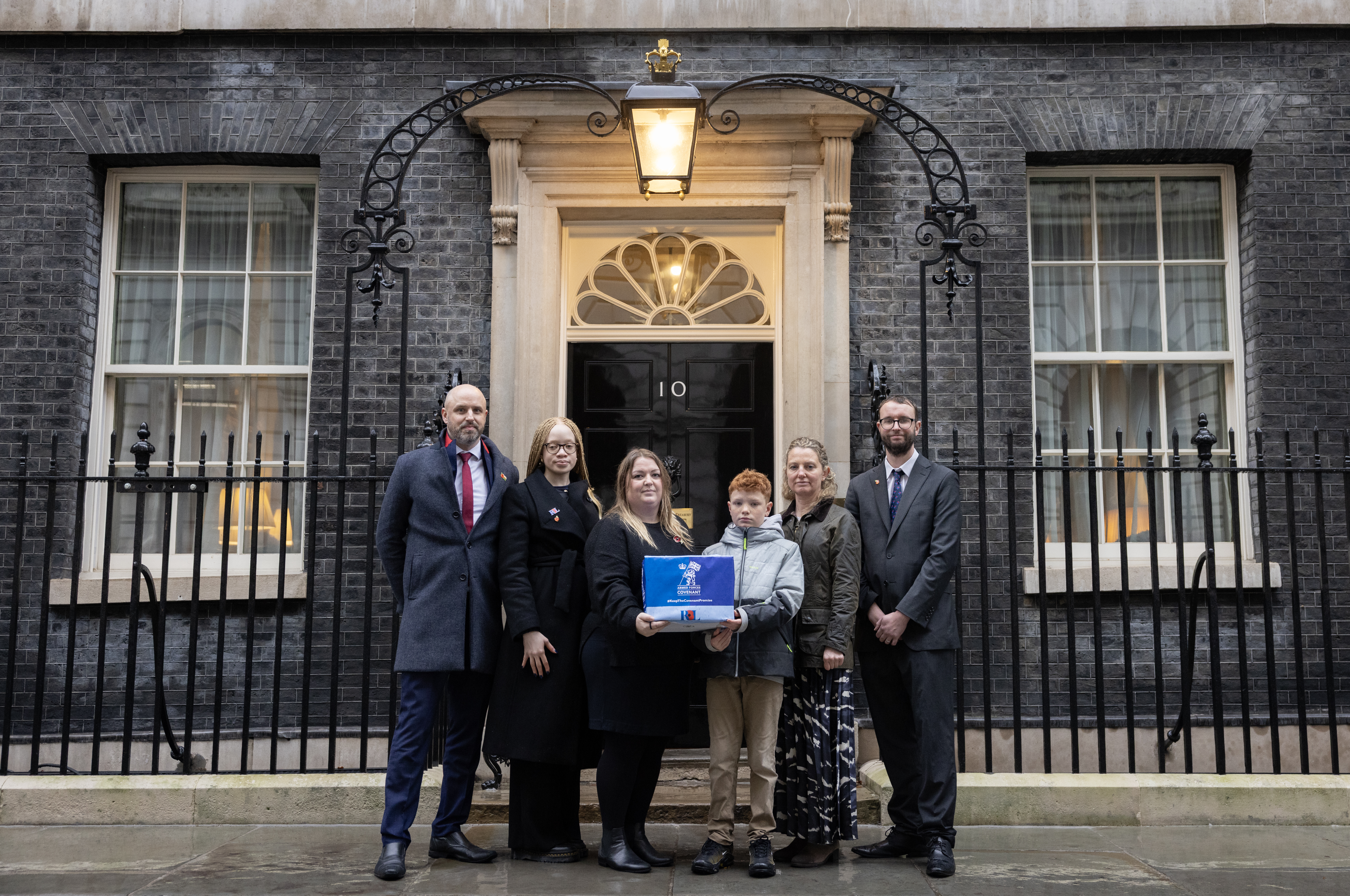
In January 2026, the RBL delivered an open letter to the Prime Minister at 10 Downing Street, signed by 4,269 supporters, calling on the Government to “Keep the Covenant Promise.”
The RBL’s Covenant report shows why special protections are needed in law to support the Armed Forces community and their families, who face unique challenges and needs, from long periods away from home to the dangers placed on their physical and mental health.
They can experience frequent relocations, families face stress during deployments and extended periods of separation, and the pressures of military life can place strain on service members and their families making it difficult accessing local services most civilians take for granted due to frequent house moves. Many children in military families experience disrupted schooling, partners may have to sacrifice their own careers due to relocations and veterans moving into civilian life can struggle with healthcare, finding suitable housing or work with their military-acquired skills. The covenant coming fully into law would seek to change all that.
The RBL’s Open Letter to the PM can be found here, and media are encouraged to share it online.